Cracking the Onion: Decoding Complex Japanese
If English is a linked list extending rightward, Japanese is an onion: the predicate sits at the very end, wrapped leftward by modifiers.

(The Onion Architecture of Japanese)
Foreword
As someone who benefited greatly from reverse-engineering the underlying logic of English, I approached Japanese with the same mindset. I dislike rote memorization. I firmly believe that if a natural language can be compiled and executed smoothly by hundreds of millions of human minds, it must run on a consistent, self-contained physical engine. So I spent countless hours combing through computational linguistics (NLP) research and combined it with my experience in dissecting complex sentences, attempting to write a "standard developer specification" for this ancient language.
During this exploration, I discovered a striking architectural contrast: if English is a "Linked List"—where the main trunk executes first, chaining prepositions and relative clauses indefinitely to the right—then Japanese is a classic "Onion Architecture". In Japanese, the most critical return value (the predicate verb) is firmly pinned at the very bottom of the stack (the sentence end), while all modifiers, environment variables, and trigger conditions wrap it layer by layer from the left.
This article is a structured set of notes I wrote for myself—a practical, field-tested methodology for fast reading and comprehension. Here, I refactor the entire Japanese grammatical system using familiar engineering concepts: argument passing, encapsulation, and access control. I hope this provides a refreshing mental model for anyone weary of brute-force memorization.
Chapter 1: Foundations of Japanese Grammar
Before tackling intimidating, deeply nested sentences, we must first standardize our basic concepts—just like reading the official API documentation before writing code. In this chapter, we will break down all basic primitives of Japanese: what they are, why they exist, and how they are classified within the runtime.
I. Primitive Data Types (Parts of Speech & The 4 Verb Engines)
No matter how complex a sentence is, once stripped down to its finest granularity, it consists of individual words. Parts of speech are the Primitive Types of a language.
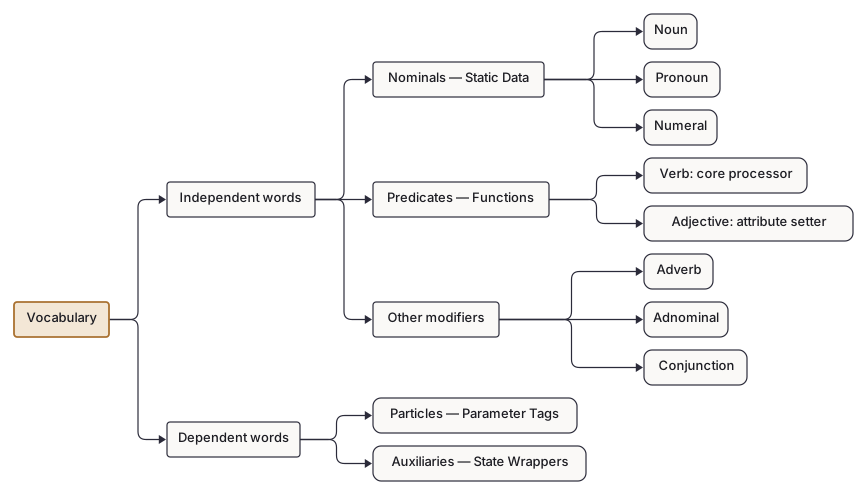
Why did humans invent so many parts of speech? The answer lies in information processing efficiency.
Take Taigen (Nouns, Pronouns, Numerals): they serve as Static Data Objects in the system. Ancient humans needed to name physical entities in the real world (apple, torch, self); only by assigning values could they load them into mental memory. Taigen includes nouns defining entities, pronouns acting as memory pointers, and numerals for counting. These three types have no inflectional endings, quietly serving as data covering 100% of static entity scenarios.
Static data alone is insufficient; we need attribute labels—this is the role of Adjectives (Yougen). They exist to distinguish a "large beast" from a "small beast". In Japanese, adjectives are split into i-adjectives (e.g., 大きい) with native tense conjugation, and na-adjectives (e.g., 便利だ) derived from nouns that require auxiliary support.
The undisputed CPU of the language is the Verb. Why did early humans invent verbs? In hunting or gathering, complete sentences were unnecessary. Spotting a predator, yelling "Run!", or finding prey, shouting "Kill!"—a single action command delivered the core survival instruction. Thus, the verb is the main() function of all syntax.
In traditional Japanese pedagogy, verbs are crudely split into "intransitive (自動詞)" and "transitive (他動詞)". This standard suffers from a severe classification bug. For instance, "to meet (会う)" clearly requires a counterpart object, yet because it takes に instead of the direct object particle を, it is forcefully labeled intransitive. To prevent runtime parsing errors during reading, I reclassified Japanese verbs into Four Core Engines based on their Valency (the number of mandatory arguments required for execution). This covers 99% of core operational actions:
- 1-Place Verbs (Intransitive Engine): A standalone function running on a single machine. Completely independent, requiring only 1 mandatory parameter (Subject
が). Example: "The flower blooms (花が咲く)". - 2-Place Verbs A (Transitive Engine): An action that directly mutates or affects a target object. Requires 2 parameters: Subject
が+ Direct Objectを. Example: "I eat rice (私がご飯を食べる)". - 2-Place Verbs B (Complement Engine): An action that does not physically mutate the target, but depends strictly on a direction, benchmark, or counterpart. Mandatory parameters: Subject
が+ Complementに/へ/と/から. Example: "I meet a friend (私が友達に会う)". - 3-Place Verbs (Ditransitive / Transfer Engine): A full resource transfer suite, typically denoting exchange or transmission. Mandatory parameters: Subject
が+ Complementに/へ+ Objectを. Example: "I send an email to the teacher (私が先生にメールを送る)".
Finally, we have Auxiliary Words (Particles & Auxiliary Verbs). They carry no standalone lexical meaning and serve purely as grammatical glue. Because Japanese is an agglutinative language, word order does not dictate syntax as rigidly as English does. Japanese relies on tagging parameters (particles) and stacking outer shells (auxiliary verbs). As long as parameter tags are placed correctly, elements can shift positions freely, and the runtime parser will resolve them without error.
II. Six Sentence Components
Parts of speech are static blueprints; sentence components are the dynamic runtime roles words play within a specific execution Context.
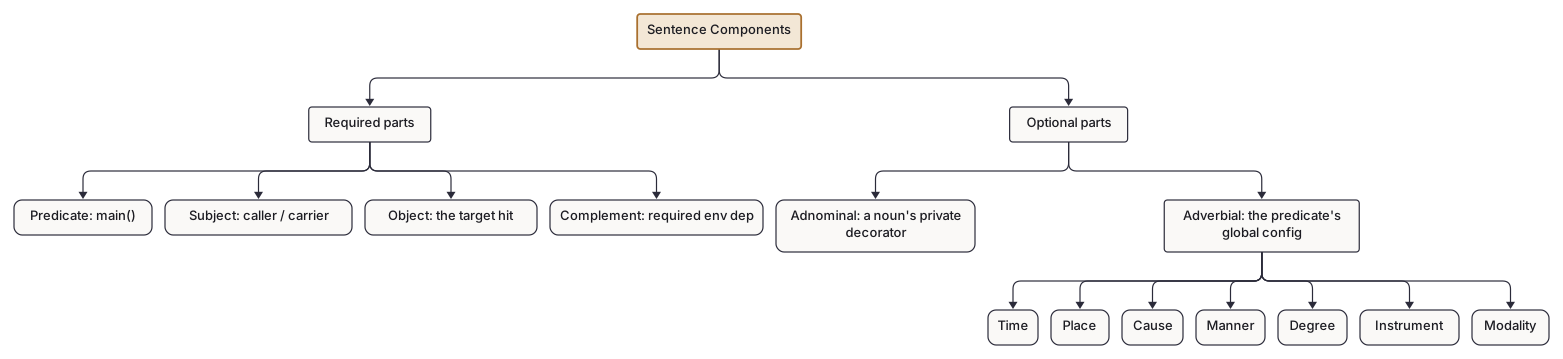
Every functioning program requires a core skeleton. The Predicate is the absolute main() function: it dictates whether the program exits, throws an exception, or returns data. Therefore, in Japanese, the predicate is pinned firmly right before the period.
To execute this function, we must declare who triggered it—this is the Subject (tagged with は or が). If the action mutates an entity, we need a target—this is the Object (tagged with を). If the action requires an environment target, origin, or direction without which the system crashes, these are Complements (tagged with に/へ/から/と, covering over 95% of directional/counterpart scenarios).
Beyond the core skeleton, real-world complexity demands modifiers:
- Attributives (Modifiers for Nouns): They function strictly as private decorators placed directly to the left of nouns. Their purpose is to narrow memory pointers down to specific instances (e.g., refining generic "car" into "the red car bought yesterday"). Whether a simple pronoun ("this"), an adjective ("beautiful"), or a full subordinate clause ("that I bought"), anything placed immediately before a noun is an attributive.
- Adverbials (Modifiers for Verbs/Adjectives): A massive configuration system positioned to the left of verbs or adjectives, acting as global runtime configs. An action's execution depends on its execution context: time (last night), location (on the server), tool (via script), degree (perfectly), or reason (due to bugs). In addition, "modal adverbials" (e.g., "perhaps", "definitely") act like preprocessor directives: appearing at the sentence start, they strictly bind with matching inferential or negative suffixes at the sentence end.
III. Five Basic Sentence Patterns
The five basic sentence patterns form the architectural templates of all Japanese sentences. No matter how long a sentence is inflated by attributive and adverbial layers, stripping away modifiers leaves a core skeleton that inevitably falls into one of these five patterns:
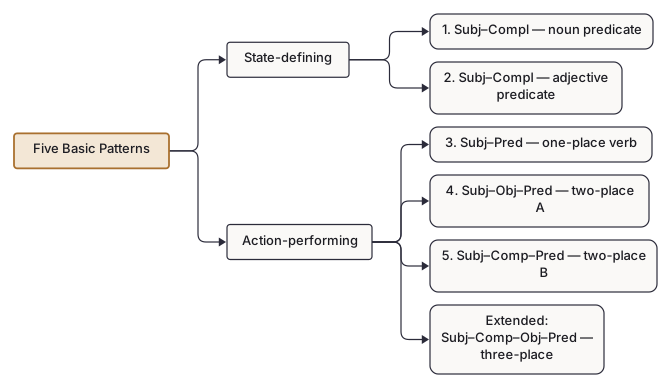
- Pattern 1: Subject-Complement (Noun Predicate / A is B):
[Subject] が + [Noun + だ]. Example: "He is an engineer." - Pattern 2: Subject-Complement (Adjective Predicate / A has property B):
[Subject] が + [Adjective]. Example: "The tool is convenient." - Pattern 3: Subject-Verb (1-Place Engine): Fully autonomous execution.
[Subject] が + [Intransitive Verb]. Example: "The system runs." - Pattern 4: Subject-Object-Verb (2-Place Engine A): Action with direct target.
[Subject] が + [Object] を + [Transitive Verb]. Example: "I write code." - Pattern 5: Subject-Complement-Verb (2-Place Engine B): Action with directional dependency.
[Subject] が + [Complement] に + [Complement Verb]. Example: "Data arrives at the server."
- Extended Pattern: Subject-Complement-Object-Verb (3-Place Engine): Full resource transfer.
[Subject] が + [Recipient] に + [Item] を + [Transfer Verb]. Example: "He assigns tasks to the team."
(Note: To keep the core skeleton clean, the Topic marker [Topic] は is omitted above. In practice, a global topic declaration can be inserted at the very front of any pattern at runtime.)
IV. Coordinate Sentences (Concurrent Threads)
When we need to state two peer-level, independent events in a single output stream, basic sentence patterns are insufficient. We introduce Coordinate Sentences, analogous to Concurrent Threads.
In Japanese, spawning two concurrent threads follows two clean mechanisms:
- Hard Link (Conjunctions): Two sentences separated by a full stop, physically isolated, bridged by an interface word (e.g.,
そして,また,しかし). Example: "He is an excellent engineer. Furthermore, he understands design." - Soft Link (Continuative Form / Te-form): Omitting the period, the predicate of the first thread is transformed into its
て-form or continuative stem, seamlessly mounting the next thread. Example: "He is an excellent engineer AND understands design (エンジニアで、デザインもできる)."
V. Three Subordinate Clauses (Nested Models)
When the information we must convey is highly complex, simple adjective or adverb parameters no longer suffice. We pack a complete sentence containing its own subject, object, and verb into a single nested component embedded within the outer main clause. This is the fundamental purpose of Subordinate Clauses—enabling logical nesting.
Unlike English, which projects clauses backward using relative pronouns (that, which), Japanese clauses are 100% left-nested and prefixed.

1. Noun Clauses (The Object Wrapper)
- What: Wrapping a full sentence in a shell to convert it into a noun block.
- Why: Because parameter slots in basic sentence patterns (Subject, Object, Complement) only accept noun-typed data.
- How: Encapsulated using nominalizers
ことorの. Once wrapped, they takeがas subject orをas object. Example: "I know [that he secretly modified the code yesterday] + こと."
2. Attributive / Relative Clauses (The Left-Decorator)
- What: Sentence-level components directly modifying nouns.
- Why: Pre-existing standalone adjectives cannot describe complex event states like "fixed late last night".
- How: In Japanese, no relative pronouns are needed. You simply drop the complete sentence directly to the left of the target noun. Example: "[The bug I stayed up late to fix yesterday] threw an error again."
3. Adverbial Clauses (The Logic Controller)
- What: Logical triggers mounted in front of the main clause.
- Why: To define the macro execution environment or prerequisites for the
main()function. - How: Appending logical conjunctive particles to the end of a clause:
- Condition (If/When): Wrapped with
ば,たら,と,なら. (e.g., "[Once an error occurs たら], check the logs.") - Reason (Because): Wrapped with
から,ので,ため. (e.g., "[Because specs changed ため], we refactored the code.") - Concession (Although): Wrapped with
のに,ても,が. - Time / Purpose / Degree: Accurately governed by
とき,ために,ほど,とおり.
- Condition (If/When): Wrapped with
Chapter 2: Guide to Decoding Complex Sentences (The Onion-Peeling Algorithm)
Understanding the architecture reveals a fundamental reality: Japanese sentences look dauntingly long solely because their relative clauses extend infinitely to the left, while adverbial clauses push the main clause deeper into the stack.
For complex English sentences, we follow forward chains and find trailing modifiers. For Japanese, because logic is reverse-nested, I developed the "Peeling the Onion" algorithm—a pure exercise in syntactic reverse-engineering.
No matter how long a sentence is, systematically execute these three steps to parse it in seconds:
Step 1: Jump Straight to the Period, Peel Outer Shells, Lock the Main Function
Never read a complex Japanese sentence strictly left-to-right; doing so causes mental stack overflow across recursive clauses.
Jump your eyes directly to the final punctuation mark. Strip away outermost emotional, conjectural, and tense wrappers (e.g., ~かもしれない, ~べきだ, ~た) like peeling onion skins. What remains exposed is the core predicate (Verb / Adjective / Noun + だ)—the main() function of the sentence.
Step 2: Fetch Parameters in Reverse Based on Verb Valency
With the main function locked, recall the Four Verb Engines:
- If it is a Transitive Verb, scan leftward for nouns tagged with
をand将. - If it is a Ditransitive Verb, scan leftward for
が,を, andに. - Null-Subject Note: Japanese frequently omits obvious subjects. If no
がis found, the subject is either "I/We", "You", or stored in a preceding topicは.
Once you extract these parameters, the core business logic of the sentence is solved.
Step 3: Package Fragments (Black-Box Attributives & Adverbials)
With the primary trunk extracted, process the remaining text as modular black boxes:
- Any block of text immediately to the left of a noun is grouped in brackets
[ ]as a relative clause—ignore its internal nuances for now. - Whenever you encounter
から,て,たら,ため, draw a divider line|—it marks a self-contained adverbial trigger.
💻 Hands-on Walkthrough
Let's test this algorithm on a typical enterprise Japanese sentence:
「昨日チーム会議で激しく議論されたその新しいデザイン案が、今朝のテスト環境で致命的なバグを引き起こしたため、リリースを延期せざるを得なかった。」
- Lock Main Function (Jump to end):
- Sentence ending:
延期せざるを得なかった - Peel emotional wrapper:
ざるを得なかった(had no choice but to...) - Core function exposed:
延期する(to postpone) — a transitive verb.
- Sentence ending:
- Fetch Parameters:
- Scan left for
を: foundリリースを(the release). - Scan left for subject: omitted, inferred as "We".
- Core trunk extracted: "We postponed the release."
- Scan left for
- Package Fragments:
- Find logic controller:
ため(because). Everything prior toためis a Reason Adverbial Clause. - Inside the reason clause:
デザイン案が (Subj)+バグを (Obj)+引き起こした (Verb)-> Sub-trunk: "The design proposal caused a bug." - Package remaining attributives:
昨日チーム会議で激しく議論されたその新しいis merely a private decorator modifyingデザイン案.
- Find logic controller:
Final Decoded Output:
[Reason Clause: The design proposal [discussed yesterday] caused a bug] --> Triggers Trunk --> We postponed the release.
What appeared to be a chaotic sentence instantly resolves into structured, deterministic code.
Chapter 3: Advanced Grammar Foundations (Pointers & Access Control)
Once you master basic patterns and the onion algorithm, you are ahead of 80% of learners. The remaining 20% of headache-inducing topics—causative, passive, giving/receiving, and keigo—are not mysterious idioms; they are Pointer Redirections and Access Control Lists (ACL).
I. Causative and Passive (Pointer Redirection)
- Passive (
~れる/られる): Pointer Inversion. The original direct object is promoted to the subject (taggedが), while the original actor is demoted to a complement (に/によって).- Example:
先生が 私を 褒める->私が 先生に 褒められる(I was praised by the teacher).
- Example:
- Causative (
~せる/させる): Injecting Root Permissions. An external controller (the boss/causer) is added as the new subject, while the actual worker is demoted to takeにorを.- Example:
私が 走る->社長が 私を 走らせる(The president makes me run).
- Example:
II. Giving and Receiving (Relative Pointers across Firewalls)
Why does Japanese have three separate words for give/receive (あげる, くれる, もらう)?
Because Japanese culture enforces a strict network firewall: "In-group (Uchi)" vs. "Out-group (Soto)". Transferring an item or benefit is not merely physical relocation; it is a cross-firewall data request requiring directional encoding right inside the verb:
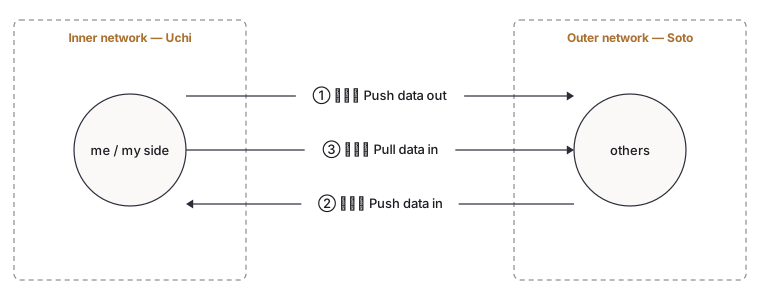
- あげる (Ageru): Data pushed outward from In-group to Out-group. Subject must be In-group.
- くれる (Kureru): Data pushed inward from Out-group to In-group. Subject must be Out-group.
- もらう (Morau): Data pulled inward from Out-group initiated by In-group. Subject must be In-group.
(Note: Stacking these after the て-form of a verb transfers not physical goods, but the "benefit of an action". The underlying directional flow remains identical.)
III. Keigo Honorific System (Access Control List / ACL)
Keigo is an Access Control List (ACL) encoded directly onto predicate suffixes or specialized vocabulary overrides to avoid "social crashes" in hierarchical runtime contexts.

- ① Sonkeigo (Admin Override / Elevate Target): Grants maximum privilege to the actor. Never used to describe oneself. (e.g.,
食べる->召し上がる, or wrapping withお~になる). - ② Kenjougo (Guest Mode / Lower Self): Lowers own privilege relative to the target. Only used for oneself or in-group members. (e.g.,
見る->拝見する, or wrapping withお~する). - ③ Teichougo (System Log Level): Courteous statement of fact without a specific elevated target. (e.g.,
行く->参る,言う->申す). - ④ Teineigo (Public API / Formatted Output): General public politeness to the listener without altering internal actor hierarchy. (e.g.,
です,ます,ございます).
💡 Pro Hacker Tip:
Because Japanese constantly omits subjects, Keigo acts as an invisible pointer. If you see a Sonkeigo wrapper (~いらっしゃる) at sentence end, the actor is unmistakably a high-privilege external target (client/boss). If you see Kenjougo (拝見する), the actor is guaranteed to be the speaker/in-group. Keigo perfectly reconstructs missing parameters in high-context communication.
Afterword
Proverbs 25:2 states:
"It is the glory of God to conceal a matter; to search out a matter is the glory of kings."
Learning a foreign language and deciphering complex sentences is fundamentally a process of "searching out a matter"—an exercise in reverse engineering.
Faced with unfamiliar word orders, if we rely solely on memorizing vocabulary lists and isolated grammar rules, we are merely applying endless patches. But when we deconstruct a language's type system, sentence skeletons, nested clauses, and onion-peeling algorithms, we gain access to its source code with structural clarity.
Code the language, don't just memorize it.